


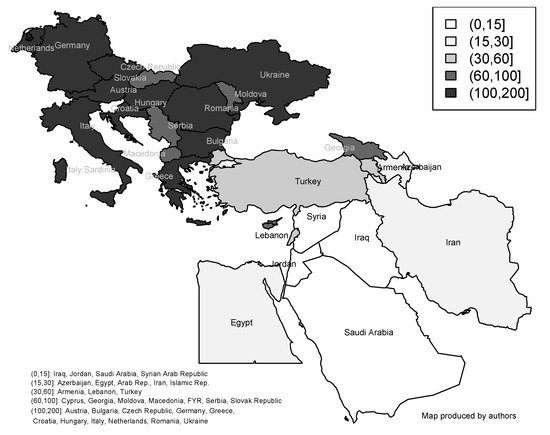
A new publication from MENARAH’s network authored by Mohamed Ismail and Professor Shereen Hussein providing a detailed review of ageing and long term care in Turkey. They also provide a novel estimation of long-term care costs in Turkey adopting an estimation model developed by the OECD. The findings of the review highlight the increasing share of older people in Turkey, the fast pace of population ageing, and escalating health and LTC unmet needs. Older people are reported to have high levels of depression, loneliness and co-morbidity with regional, gender and educational differentials. The Turkish LTC and welfare models rely on the family, particularly women, in meeting increased demand. A hierarchical model with random intercept was implemented and estimated the LTC cost in Turkey to be 0.02% of GDP, acknowledging the high proportion of people at labour participation age range and low female employment levels.
Current evidence highlights the increasing demand for LTC services in Turkey. While there have been some notable efforts in implementing and expanding LTC provision, there remain considerable gaps in provision and access to services. The Turkish LTC and welfare models rely on the family, particularly women, to provide care and state support usually comes from financial assistance to the most vulnerable groups. Evidence indicates that such reliance on the family might not be sustainable or suitable in meeting the significantly increasing LTC burden. However, due to current large cohorts of young people in the labour participation groups, linked to population dividends and low female labour participation rates, LTC expenditures in Turkey is estimated at only 0.02% of its GDP. This rate is considerably lower than its neighbouring European countries and acknowledges the current state of its young population and the role the family plays in LTC provision. There is currently a window of opportunity for Turkey to further develop and expand LTC provision before transitioning from ageing to an aged society over the next couple of decades.
This article is open access and can be accessed free of charge here. It is also part of a special issue of Sustainability, which is Guest Edited by Professor Shereen Hussein. This issue titled “Sustainable Care: Facing Global Ageing More Effectively” provides a selection of articles specific to sustainable care from a global perspective including the impact of the COVID-19 pandemic on formal and informal care; on family carers of people living with dementia; how to optimise assistive technology to support population ageing and the role of live-in care and migrant workers in providing care at home among others. The special issue presents comparative research from a large number of countries and in-depth evidence from Turkey, Slovenia, Norway and Italy.

Director, Analytical Research Ltd, and Affiliate Research Fellow, Oxford Institute of Population Ageing, University of Oxford, United Kingdom
Mohamed Ismail is a quantitative researcher whose work develops mathematical and computational frameworks to better understand ageing dynamics and long-term care systems, with a particular focus on how time spent in care shapes future demand, costs, and system behaviour.
With a background spanning engineering, computer science, and mathematical finance, he brings a structured, model-based perspective to complex social challenges. His recent research focuses on duration-dependent processes, how individual-level dynamics translate into population-level outcomes, and the development of tractable models of ageing and long-term care.
His recent work includes the development of a new index-based framework for estimating long-term care needs in data-scarce settings, with evidence from the Middle East and North Africa, published in Population Health Metrics in 2026. His research also examines long-term care policies and financing in the region, including how care systems can be integrated into broader economic and social development strategies.
Mohamed began his career as a quantitative analyst with global financial institutions, including Merrill Lynch, HSBC, Mizuho Financial Group, and Credit Suisse, before transitioning to quantitative social research. In 2009, he founded Analytical Research Ltd, applying statistical and mathematical modelling to policy-relevant questions in ageing and care.
He has collaborated with academic and policy institutions across the UK, Europe, Australia, and the Middle East on research spanning population ageing, migration, and long-term care systems. His work appears in peer-reviewed journals and international policy reports, including contributions to reports by the U.S. Census Bureau, United Nations, World Bank, and World Health Organization.
Mohamed has been a core member of the MENARAH Network since 2019, contributing quantitative and interdisciplinary perspectives to research on ageing and long-term care in the Middle East and North Africa.

Founder and Director
Shereen Hussein is a Health and Social Care Policy professor at the London School of Hygiene and Tropical Medicine (LSHTM), United Kingdom.
Shereen Founded the MENARAH Network in 2019, through an initial grant from the Global Challenge Research Fund, UKRI. She is a medical demographer with expertise in ageing, family dynamics, migration and long-term care systems. Shereen regularly collaborates with the United Nations, the World Health Organisation and the World Bank in policy and research focused on ageing in the Middle East and North Africa Region.
Shereen received her undergraduate degree in statistics and a postgraduate degree in computer science at Cairo University. She completed an MSc in medical demography at the London School of Hygiene and a PhD in quantitative demography and population studies at the London School of Economics and Political Science, United Kingdom.
 English
 Arabic