


Photo by Josue Isai Ramos Figueroa on Unsplash
Consider a man who has spent three decades on construction sites in the Gulf. At sixty, he returns to his village outside Lahore with a damaged back, no pension, and savings depleted by the debts that first financed his migration and by years of supporting his family through remittances. His chronic pain goes untreated because he cannot afford private healthcare, while neither the state whose cities he helped build nor the state whose economy benefited from his remittances accepts responsibility for his care.
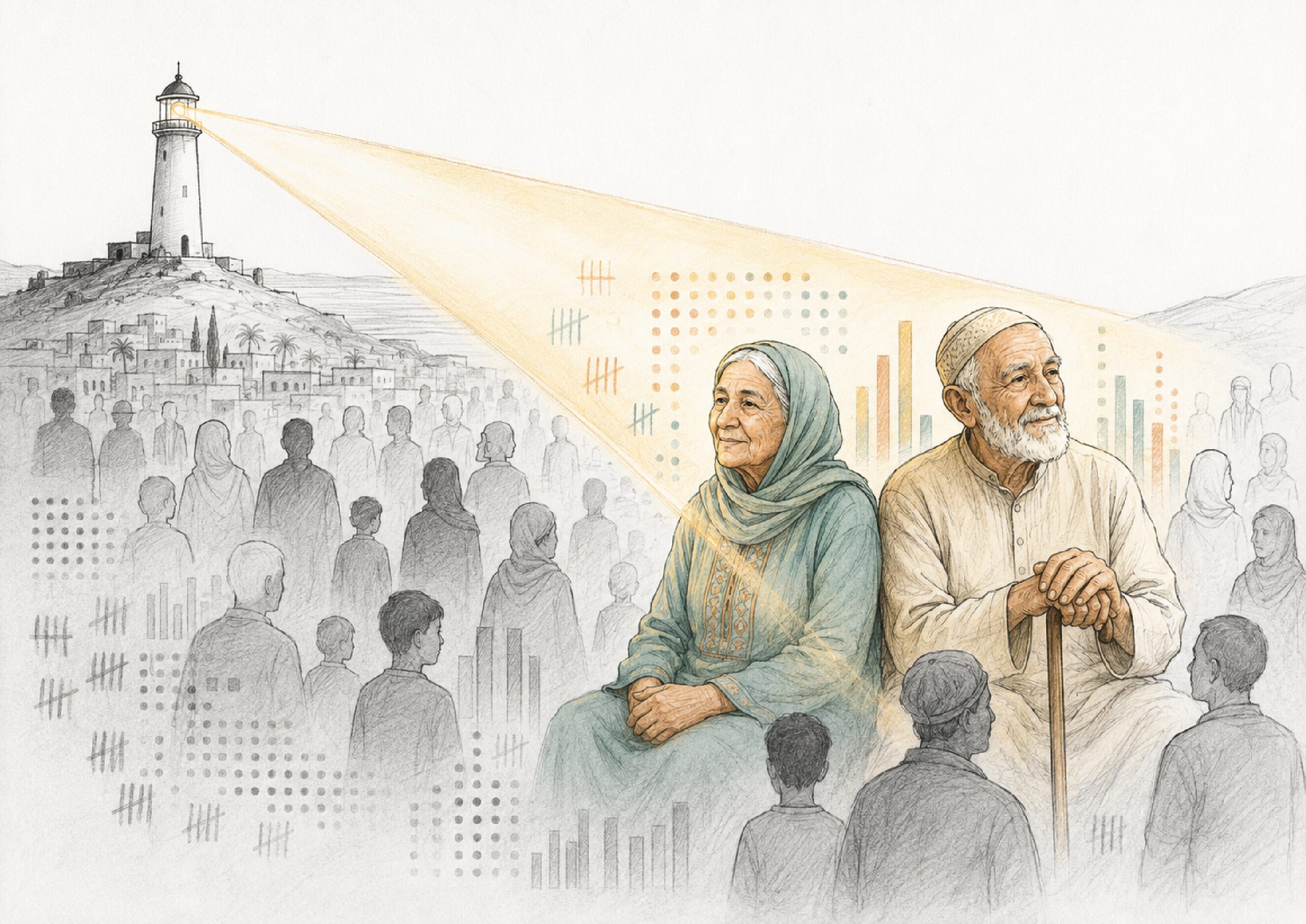
This is not an individual misfortune but the predictable outcome of a migration system designed around temporary labour. Across the Gulf Cooperation Council (GCC), the kafala (sponsorship) system has long tied migrant workers’ legal status to their employers, facilitating a model of labour migration in which workers are valued primarily for their productive capacity. When contracts end or when ageing and physically demanding work make them less employable, many are expected to return home with limited access to pensions, healthcare, or long-term social protection. While the precarity experienced by migrant workers in destination countries has rightly attracted significant attention, a quieter crisis is unfolding on the other side of the migration corridor. As thousands of South Asian migrants return in later life, sending states often lack the healthcare systems, pensions, and elder-care infrastructure needed to support them. The result is an invisible ageing crisis that exposes the long-term human costs of an economic model built on remittance dependency.
Bridging the Corridor: The MENARAH Perspective
This dynamic highlights why the MENARAH Network’s broad perspective, which critically bridges the MENA region with South Asian nations like Pakistan, is so vital. Migration along the South Asia-GCC corridor cannot be understood solely by looking at destination-state policies. Instead, it must be analysed as an interconnected, cross-regional circuit where the political economies of both regions actively produce the ageing and long-term care crises in South Asia.
The Illusions of Export-Oriented Citizenship
As I argue in my thesis, this structural gap is a direct consequence of a governance model I term export-oriented citizenship. Under this regime, sending states actively institutionalise labour migration as a core macroeconomic strategy. Citizens are governed primarily as economic instruments designed to generate vital remittance inflows that stabilise national balance sheets. Yet, this state-led model operates on a profound temporal contradiction: sending states eagerly reap the youthful economic benefits of migration but entirely fail to plan for the long-term care and financial security of their ageing, returning populace.
The Structural Extraction of Youth and the “Bachelor” Regime
When older Pakistani, Indian, or Bangladeshi workers return after decades in the Gulf, they do not transition into a restful retirement. Instead, they land in a domestic policy vacuum. This is because the corridor is explicitly designed to extract their youth while absolving destination states of the long-term costs of life, ageing, and care.
A primary instrument of this racialised governance is the legal and social category of the “bachelor.” Applied almost exclusively to South Asian men regardless of their actual marital status, the bachelor designation denies family reunification rights and enforces spatial segregation through isolated labour camps (Al-Shehabi, 2019). Employers favour “bachelors” precisely due to their limited social claims, lower costs, and ease of deportation, which systematically reduces the likelihood of political mobilisation (Al-Shehabi, 2019). Zoning laws in Gulf cities explicitly exclude these workers from family neighbourhoods, reinforcing their total exclusion from society (Al-Shehabi, 2019).
By weaponising the “bachelor” category, destination states ensure that a worker’s prime, reproductive years are entirely consumed by labour, leaving them to return home with three overlapping precarities:
- Exclusion from Safety Nets: Because they spent their working lives abroad under temporary contracts, they are excluded from formal state pension schemes back home.
- Depleted Capital: The financial capital they accumulated through remittances is frequently exhausted along the way, spent on immediate family survival, children’s education, or debt repayment incurred during the exorbitant recruitment process.
- The Toll of Labour: A lifetime of precarious, intense, and unregulated physical labour in the Gulf takes a devastating toll on the body, leaving returning older migrants with complex chronic health conditions and acute long-term care needs, completely severed from any state-backed safety net.
Who Gets Left Behind?
The “bachelor” regime is only one face of a deeply gendered system. On the other side of the coin, while men are confined to labour camps abroad, the households they leave behind are sustained largely by women, wives, daughters and mothers who raise children and manage on irregular remittances. As noted by Desai & Banerji (2008), while male migration may be associated with a higher likelihood of remittances, women may need to fill in for absent husbands in many ways, including caring for animals and working on the family farm or in the family business. In fact, very little research has been conducted on the effects on the left-behind families of these male migrants. Ultimately, they do become the unpaid carers for husbands whose health has been worn down by the corridor.
Women who migrate in their own right, overwhelmingly as domestic workers, are more exposed still: hidden inside private homes, excluded from even the limited protections other workers receive, and among the first to be dropped from consular support when they need it most. For multiple reasons, migrant domestic workers are the most vulnerable and are most likely to experience degradation within the kafala. The foremost and most compelling instance of degradation is the experience of physical, sexual, mental and verbal abuse that many women report. Some narratives of abuse include forms of extreme torture – burning, electrocution, severe beating and maiming, usually perpetrated by their employers (Fernandez, 2021). Thus, any honest reckoning with the corridor’s costs has to count the women who bear them at both ends. This adds to the “triple burden” that women from lower-income countries tend to bear (European Institute for Gender Equality, 2024).
The Pakistan Case: Exceptional Governance Failures
While this precarity affects the entire region, my research demonstrates that Pakistani workers are worse off in comparison to their South Asian counterparts due to a compounding web of structural failures that begin long before departure:
- Institutional Fragmentation and Legislative Stasis: Unlike its regional neighbours, Pakistan lacks a central body for coordinating migration-related data or a cohesive analytical framework. This fragmentation signals a deeper governance logic that deprioritises migrant welfare in favour of sustaining remittance flows with minimal state accountability. Consequently, welfare programs are inconsistently implemented, and grievance redress is dispersed across uncoordinated agencies, leaving older returning migrants procedurally disoriented and neglected.
- Informal and Unregulated Recruitment: The pre-departure recruitment system remains largely informal, frequently pushing migrants into irregular and highly exploitative situations that diminish their long-term financial security before they even board a plane.
- A Politically Marginal Consular System: Pakistan’s consular presence in the GCC is notably the weakest among the major South Asian sending states. Missions are typically under-resourced, and staff lack specialised training or legal authority. Crucially, there are virtually no mechanisms for legal aid, repatriation, or sustained support (Shah & Khan, 2023). Vulnerable groups such as undocumented workers and domestic labourers are routinely excluded from assistance by systemic omission, accelerating their physical and financial depletion by the time they return home to age.
The Domestic Burden of Care
With the state systematically absent, the immense financial and emotional burden of elder care is shifted entirely onto fragile, under-resourced family networks. This creates a vicious cycle: families must absorb the medical costs and care responsibilities of an ageing relative, which can in turn plunge the next generation into economic precarity, prompting them to look once again to the Gulf as a pathway out of poverty.
Yet this is not solely a South Asian crisis. The Gulf and wider MENA region are themselves entering a period of demographic ageing. Across many countries in the Islamic world, fertility rates are declining while life expectancy continues to rise, leading to a steadily growing older population (Hekmatnia et al., 2021). As Gulf states confront their own expanding care needs, the vulnerabilities exposed by the South Asia–GCC migration corridor become increasingly relevant across both sending and receiving countries. The absence of sustainable long-term care systems, reliance on transnational labour, and limited social protection are therefore shared regional challenges rather than problems confined to migrant-sending states. Ultimately, the South Asia-GCC migration corridor exposes an extractive and uneven landscape of global mobility. If the work of MENARAH teaches us anything, it is that ageing with dignity requires holistic, cross-regional, rights-based structural support. Until sending states move away from an economic model that treats citizens as finite export commodities and receiving states invest in sustainable systems of social care, the human cost of remittances will continue to be borne by an invisible generation of older, returned, and unprotected workers.
What would change this
This trajectory is not inevitable. The migration corridor that has generated these inequalities can also be redesigned to distribute responsibility more equitably across sending and receiving states.
For Gulf destination countries, the priority is to ensure that migrant workers are protected not only during employment but across the full migration cycle. Existing reforms provide a foundation on which to build. Wage Protection Systems (WPS), now implemented across GCC member states, have improved transparency in wage payments but require stronger enforcement, broader coverage, and more effective mechanisms for redress, particularly for vulnerable migrant workers (ILO & GCC Executive Bureau, 2025). Likewise, end-of-service indemnity schemes remain the principal form of old-age protection for many migrant workers in the Gulf, yet their benefits are often inadequate and disconnected from longer-term social security. The ILO has therefore recommended reforms that would strengthen portability, improve benefit security, and progressively align these systems with international social protection standards (ILO, 2023). Expanding bilateral social security agreements between Gulf destination states and South Asian countries would further ensure that workers can retain pension entitlements and other accrued benefits after returning home.
Sending states must complement these reforms by investing in healthcare, pensions, and long-term care for returned migrant workers while negotiating stronger bilateral agreements that recognise migration as part of a worker’s entire life course. Rather than treating labour migration as a temporary export strategy, governments should recognise returning migrants as citizens with enduring social rights and care needs.
This is precisely the kind of shared agenda that the MENARAH Network seeks to advance. As populations age across both South Asia and the Gulf, migration governance must move beyond managing labour flows to building systems of lifelong social protection. A worker’s rights should travel as readily as their labour, from recruitment and employment through return, retirement, and old age.

Iram Amir
Iram Amir is an independent migration researcher specialising in the political economy of labour migration within the South Asia-Gulf Cooperation Council countries’ corridor. They hold a BSocSci (Honours) in Sociology from the National University of Singapore and an MSc with Distinction in Migration, Mobility and Development Studies from SOAS, University of London. Their research introduces the framework of “export-oriented citizenship” to analyse state-led labour export, remittance dependency, and transnational protection regimes. Their work applies this political-economy lens to highlight the long-term structural precarities and invisible welfare gaps faced by returning transnational contract workers.

 English
  Arabic