

A reflection from the MENARAH Network on World Population Day, 11 July 2026
Every World Population Day invites us to think about who is being counted and who is being left out.
The day was created to focus attention on the urgency and importance of population issues, and it usually arrives wrapped in familiar images: growing cities, young workforces, the promise and pressure of a rising global population. In the Middle East and North Africa (MENA), that familiar story has long been a story about youth. This year, I want to tell a different one.
Across the MENA region, the fastest demographic change is happening at the other end of the life course. Older people are the part of our population growing most quickly, and they remain the part our policies, our research and our health systems are least prepared to see. World Population Day is a fitting moment to say plainly: an ageing population is not a problem arriving in some distant future. It is here, it is accelerating, and the people living it are too often invisible in the very systems meant to serve them.
The transition we are not ready for
The numbers are striking once you look for them. The number of people aged 60 and over in the MENA region is expected to triple by 2050. Across the Arab region, the older population is projected to nearly triple to around 94 million people by mid-century, roughly 13 per cent of the total. What took France around 150 years, several countries in our region are set to do in two or three decades. The Islamic Republic of Iran and Lebanon are already moving through this transition and are expected to complete it within about twenty years. Egypt is forecast to enter it by 2037.
This is one of the fastest demographic transitions anywhere in the world, and it is unfolding alongside a heavy and rising burden of non-communicable diseases. People are living longer, but not necessarily living well: in the WHO Eastern Mediterranean Region, average life expectancy at birth rose by nearly five years between 2000 and 2019, while healthy life expectancy rose by less than four. The gap between living and living in good health is wider for women, who tend to outlive men and spend more of those additional years in poor health.
What makes this transition so demanding is not ageing itself. It is that our formal systems, our long-term care arrangements, our data infrastructures, our laws, have not kept pace. Care still rests overwhelmingly on families, and within families on women, often without recognition, support or pay. The World Health Organization has noted that in most MENA countries, the large majority of long-term care is delivered by unpaid female family members. This “silent system” is culturally rooted, but it is under growing strain from smaller households, urbanisation, rising women’s labour force participation, conflict and displacement.
The invisibility problem
If you wanted to design a population group to be overlooked by evidence and policy, you might design something close to the situation of older people in our region. They are frequently excluded from national household surveys. There is little nationally representative, individual-level data on their care needs. Definitions of disability and dependency vary from country to country, making comparison almost impossible. And the issues that matter most to them, functional decline, care dependency, abuse, social isolation, are precisely the ones that are hardest to measure and easiest to leave out.
This invisibility is not neutral. It shapes how resources are allocated, whose needs are forecast, and which problems are treated as real. When older people are missing from the data, they are missing from the plan. Reactive scramble replaces strategic preparation, and the gap between what older people need and what systems provide widens year after year.
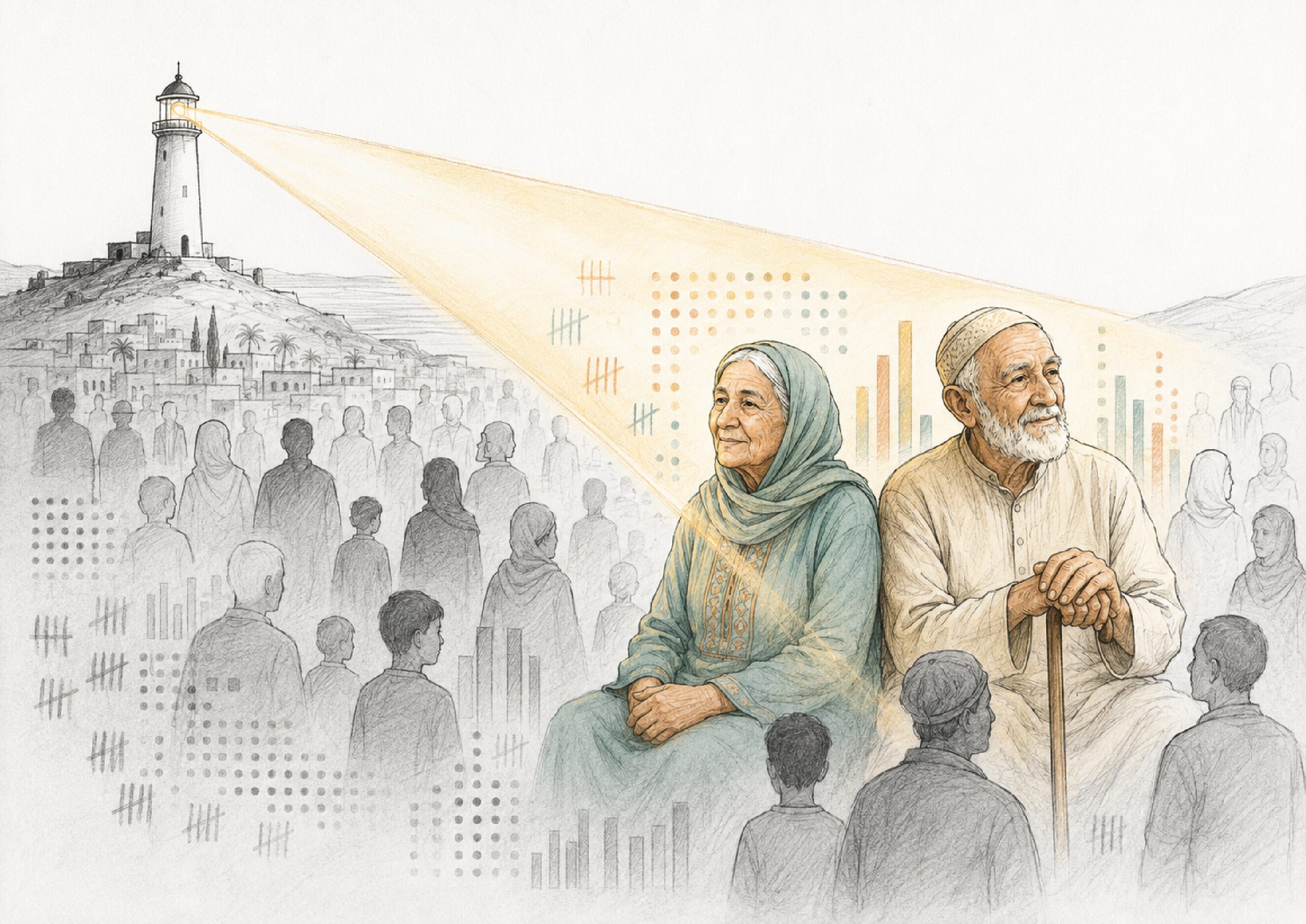
Over the past few years, the MENARAH (lighthouse in Arabic) Network has worked to close that gap. Founded in 2019 to enhance the lives of older people and their informal carers across the MENA region, the Network now brings together more than 500 researchers, policymakers, practitioners, civil society partners, older people themselves and their carers. On this World Population Day, I want to share four pieces of recent work that, collectively they show both how invisible older people remain and how that invisibility can be challenged.
Four windows onto a hidden population
Mapping the evidence gaps, with the World Health Organization. Our research with the WHO Centre for Health Development on unmet health and social care needs in the Eastern Mediterranean Region laid bare just how thin the evidence base is. A systematic review found only twenty-one peer-reviewed studies across the entire region, with estimates of unmet health care needs ranging wildly from 10 per cent in one setting to 84 per cent among Syrian refugees in Lebanese camps, depending entirely on population, condition and context. Studies measuring unmet social care needs could be counted on one hand. Only a handful of countries have begun systematic data collection on the functional status, care arrangements or unmet needs of older adults. The report did not stop at diagnosing the problem; it proposed practical alternatives for estimating need where direct data are missing, and showed how something as simple as social contact data can reveal that older people in several countries in the region have far fewer daily social connections than their counterparts elsewhere, with real consequences for health and for the uptake of care.
Measuring long-term care needs, with the World Bank. Where data are scarce, we need tools that work with what exists. Our work developing a population-based Long-Term Care Needs Index, recently published in Population Health Metrics, does exactly that. It combines demographic ageing, disability prevalence and the burden of major non-communicable diseases into a single, validated estimate of the share of a population likely to need long-term care, using internationally standardised data sources so that countries can be compared on a consistent basis. Applied across eight MENA countries, it revealed enormous variation, from around 3 per cent of the population in Oman to nearly 23 per cent in Saudi Arabia, and a clear upward trend everywhere through 2030, driven mainly by ageing. It also showed that the drivers of need differ from country to country: disability dominates in most, while in Qatar diabetes alone accounts for a larger share of need than disability does. That kind of attribution matters, because it tells policymakers not just how large the need is, but what is causing it, and therefore what to do. The Index is a diagnostic tool for exactly the data-scarce settings our region is full of, and it is transferable well beyond MENA.
Breaking the silence on elder abuse, with the United Nations. Some forms of invisibility are actively maintained. Our work with UN ESCWA and UNFPA on elder abuse in the Arab region, published as Breaking the Silence, confronts one of the most hidden harms older people face. Globally, the WHO estimates that one in six older people experienced some form of abuse in the past year, and the figures we have are almost certainly underestimates. In our region, cultural narratives that treasure older people can paradoxically conceal their mistreatment, as families stay silent to protect their reputation and older people themselves normalise neglect, financial control or emotional harm as ordinary family life. Drawing on lived experience from Jordan, Lebanon and Yemen, the report shows how emotional abuse, neglect and financial exploitation dominate, how older women are disproportionately affected, and how conflict sharpens every vulnerability. Crucially, it found that of twenty-one Arab constitutions, only Jordan’s explicitly protects against elder abuse, and only seven countries in the region have stand-alone laws on older persons. Reporting mechanisms, where they exist at all, are usually grafted onto hotlines built for violence against women or child protection, poorly suited to older survivors who often depend on their abuser for daily care. Breaking that silence begins with naming the problem and counting it honestly.
Claiming rights, at the United Nations. Finally, this work is converging on a historic opportunity. In April 2025, the UN Human Rights Council mandated the drafting of an international legally binding instrument on the human rights of older persons. This is a once-in-a-generation chance to move older people from the margins of welfare and charity to the centre of enforceable rights. MENARAH has submitted detailed input to the OHCHR call ahead of the Intergovernmental Working Group’s first session in July 2026, calling for a genuine shift from a welfare model to a rights-holder model, and for the new convention to close long-standing gaps on long-term care, elder abuse, the rights of informal carers, social isolation, chronic illness, humanitarian and displacement contexts, legal capacity and digital exclusion. We have argued that the instrument must reflect the realities of our region, where rapid ageing meets protracted conflict, fragmented care systems and some of the world’s most severe climate hazards. Engagement from MENA states in this process has so far been partial and uneven. That has to change, and civil society has a central role in changing it.
What World Population Day asks of us
These four strands, evidence gaps with WHO, measurement with the World Bank, abuse with the UN, and rights at the global level, are really one argument made four ways. Older people in our region are growing in number and shrinking in visibility, and the distance between those two facts is where harm lives.
World Population Day is, at its heart, about the dignity of being counted. So this is my appeal. Invest in nationally representative data on ageing, disability and care dependency, because what is not measured is not planned for. Build long-term care systems before the pressures of ageing become overwhelming, rather than after. Recognise and support the women who hold our care systems together, largely unpaid and unseen. Name elder abuse, legislate against it, and create ways to report it that older people can actually use. And engage, seriously and together, with the new UN convention, so that the rights of older persons in MENA are written in rather than assumed away.
The demographic transition reshaping our region is not a wave we can hold back. But whether older people move through it with dignity, security and rights, or whether they remain unseen and unheard, is a choice we are making right now, in every survey we design, every budget we set and every law we pass.
A lighthouse (MENARAH) exists to make sure no one is lost in the dark. On this World Population Day, let us make sure our older people are counted, seen and heard.
Further reading
- Evidence Gaps on Unmet Health and Social Care Needs in the WHO Eastern Mediterranean Region (World Health Organization, 2025)
- Ismail, M., Kanth, P.D. and Hussein, S. (2026). Estimating long-term care needs in data-scarce settings: a diagnostic model with evidence from MENA. Population Health Metrics, 24:42
- Breaking the Silence: Addressing Elder Abuse in the Arab Region (UN ESCWA / UNFPA, 2026)
- MENARAH Network Submission to the OHCHR Call for Inputs on a Legally Binding Instrument on the Human Rights of Older Persons (April 2026)
Photo credit: created through instructions using ChatGPT AI Gen model.
Founder and Director
Shereen Husseinis a Health and Social Care Policy professor at the London School of Hygiene and Tropical Medicine (LSHTM), United Kingdom.
Shereen Founded the MENARAH Network in 2019, through an initial grant from the Global Challenge Research Fund, UKRI. She is a medical demographer with expertise in ageing, family dynamics, migration and long-term care systems. Shereen regularly collaborates with the United Nations, the World Health Organisation and the World Bank in policy and research focused on ageing in the Middle East and North Africa Region.
Shereen received her undergraduate degree in statistics and a postgraduate degree in computer science at Cairo University. She completed an MSc in medical demography at the London School of Hygiene and a PhD in quantitative demography and population studies at the London School of Economics and Political Science, United Kingdom.

 English
  Arabic